


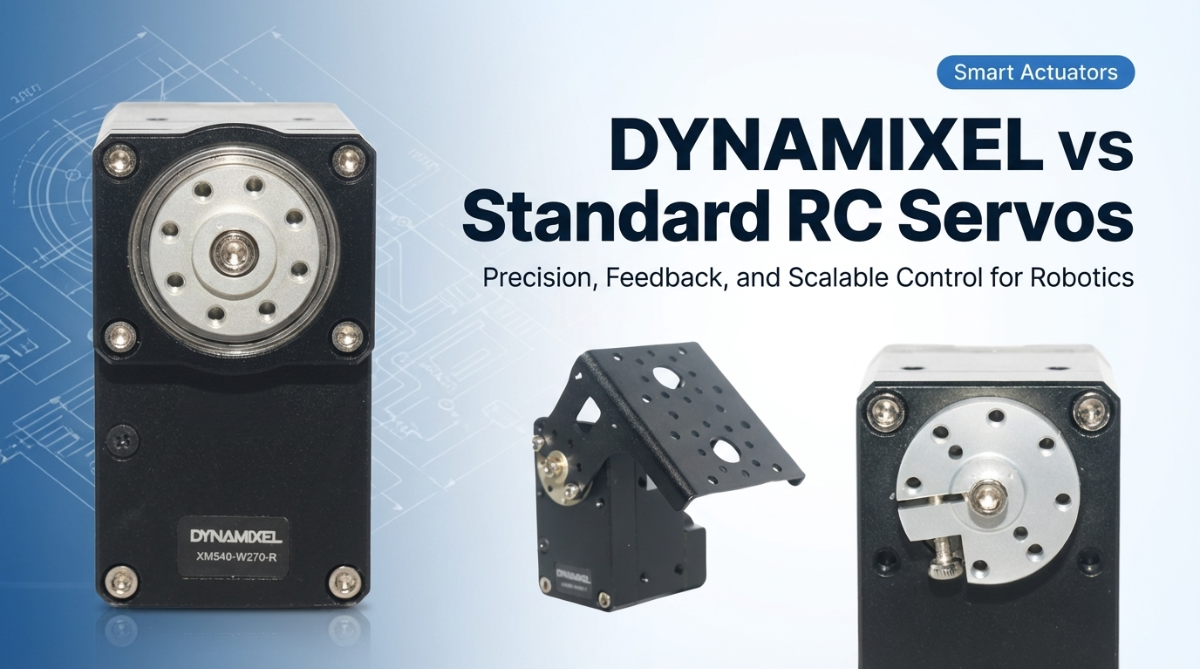
DYNAMIXEL vs. RC Servos: What Sets Them Apart in Real Robotics
Posted by Mason Knittle on 24th Mar 2026
Robots demand more than simple motion. In many hobby and educational projects, a standard RC servo is “good enough” to move a mechanism from point A to point B. However, as soon as you need precision, repeatability, multi-axis coordination, and reliable performance under load, the limitations of standard RC servos can show up quickly.
DYNAMIXEL was created for robotics applications where motion is part of a complete system, not a standalone component. Below is a practical comparison of what’s different, why it matters, and where DYNAMIXEL provides a clear advantage.
1) Control: Digital Precision vs PWM Simplicity.
- You can configure how each actuator behaves, including torque limits, speed profiles, and compliance, not just where it should go.
- Digital control scales efficiently when you have many actuators in one robot, supporting coordinated multi-joint motion.
- Real-time feedback helps diagnose issues and ensures predictable performance under varying loads.
- No direct feedback on torque, speed, or load.
- Behavior cannot be finely tuned beyond position; torque limits and speed profiles are mostly fixed.
- Scaling to multiple actuators requires extra wiring and careful timing to avoid conflicts.
- Performance under varying loads can be inconsistent, making repeatable motion harder to achieve.
2) Feedback and visibility: Know what your robot is doing, not what you told it to do
- Easier troubleshooting and validation during development using measurable motion data.
- More reliable behavior in robotics applications where load changes frequently.
- Better protection against overdriving mechanisms by monitoring what the actuator is actually doing.
- Troubleshooting often relies on symptoms (sound, heat, drift) rather than measurable data.
- Detecting stalls or overload conditions may require extra sensors or conservative safety limits.
- Behavior under varying loads can be less predictable, especially in multi-joint mechanisms.
3) Multi-servo robotics: Designed for networks, not one-off channels
Standard RC servos are often used one per channel, which works well for simple mechanisms. However, as a robot grows to include many joints, wiring complexity and controller requirements increase quickly. Managing multiple PWM channels, routing power cleanly, and keeping behavior consistent across servos can become a significant integration challenge.
DYNAMIXEL is designed for multi-actuator robotics platforms, allowing many actuators to be controlled as a coordinated group. This approach aligns with how modern robotics systems are built and maintained, helping teams keep electrical architecture cleaner and ensuring consistent control behavior across the entire robot.
Why this is better: It enables seamless scaling from just a few actuators to 20+, with maintainable wiring and cleaner system architecture as robots grow more complex.
Example: A humanoid, quadruped, or mobile manipulator can be built with a consistent actuator interface and unified control across all joints, making setup and maintenance simpler.
4) Software ecosystem: Faster development with robotics-ready tooling
One of the biggest “hidden costs” in robotics is software time: writing boilerplate code, managing protocol details, and building tools just to get motion working reliably.
DYNAMIXEL provides an ecosystem designed to reduce that overhead. For example, the DYNAMIXEL Easy SDK simplifies servo control and accelerates prototyping by hiding low-level packet handling and protocol details. Developers can use high-level calls to set and read positions, speeds, or torque without worrying about underlying protocols.
Why this is better: Less time spent on low-level control plumbing means a faster path from concept to a working prototype.
Example: A lab team can bring up a multi-joint demo quickly using a high-level API to command and monitor multiple actuators, rather than implementing packet parsing and register management from scratch.
5) Choosing the right actuator for your project
For simple mechanisms with modest requirements, a standard RC servo can be a cost-effective choice.
For robots where motion needs to be precise and repeatable, diagnosable and maintainable, scalable to many joints, and controllable with robotics-grade software tools, DYNAMIXEL is the better actuator platform.
It is engineered for system integration and long-term robotics development, not just basic motion.