


Powering Large DYNAMIXEL Daisy Chains: What You Need to Know
Posted by Mason Knittle on 31st Dec 2025
Powering Large DYNAMIXEL Daisy Chains: What You Need to Know
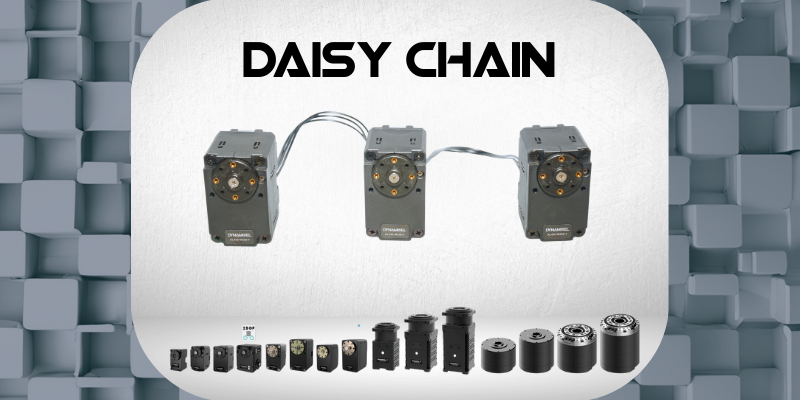
One of the biggest advantages of DYNAMIXEL servos is how easy they are to connect. A single cable carries power and communication, and servos can be daisy-chained together almost indefinitely. This works beautifully for small systems - but once you start building robots with many servos, power delivery quickly becomes the most common failure point.
This article focuses on how to properly power large DYNAMIXEL daisy chains, why problems occur as systems scale up, and what design techniques you can use to keep your robot stable and reliable. While the XL330-M288-T is used as a concrete example, the principles here apply to all DYNAMIXEL models.
Why Power Is the Hard Part of Daisy-Chaining
In a DYNAMIXEL daisy chain, all servos share the same power rails. The supply voltage enters the chain at one point and must pass through each connector, cable, and internal PCB trace before reaching the next servo. As long as the total current is small, this arrangement works without issue. As more servos are added, however, the electrical burden placed on that shared path increases rapidly.
The key point is that while the voltage is nominally the same throughout the chain, current demand accumulates. Each additional servo increases the total current flowing through upstream wiring and connectors. Eventually, the power distribution network, not the servos themselves, becomes the bottleneck that limits reliability and performance.
Voltage, Current, and the Reality of Servo Loads
When designing power for a large DYNAMIXEL system, it helps to clearly separate voltage, current, and real-world servo behavior. These concepts are closely related, but each contributes differently to system stability.
Voltage Is Shared Across the Chain
- Every servo in a daisy chain receives the same nominal supply voltage
- Each DYNAMIXEL model specifies a valid operating voltage range
- If voltage drops below the minimum threshold at any point, servos may reset or shut down
Even when the supply is correctly set at the source, voltage at the far end of a long chain can be significantly lower due to wiring and connector losses.
Peak Current Matters More Than Average Current
Many power issues don’t show up when the robot is idle. They appear:
- When multiple joints accelerate at once
- When the robot contacts the environment
- When servos hold heavy loads
These brief spikes can pull voltage below a servo’s minimum operating threshold, causing:
- Brown-outs
- Servo resets
- Communication dropouts
Best Practices for Powering Large DYNAMIXEL Chains
Your power supply should:
- Match the servo voltage rating
- Provide significantly more current than average demand
- Handle short, high-current transients without sag
As a rule of thumb:
Budget 1–1.5 A per small servo and add extra margin for simultaneous motion
A supply that operates comfortably below its limit will always perform better than one pushed to the edge.
Feeding power into only the first servo works for small chains, but scales poorly.
Instead, use multiple power injection points:
- Inject power at several locations along the chain
Many DYNAMIXEL servos can report their input voltage. Use this feature to:
- Check voltage at different points in the chain
- Identify weak spots in your power distribution
- Validate changes after adding servos or loads
Testing under real operating conditions is crucial, bench tests at idle are misleading.
Common Failure Symptoms
Power-related issues often follow recognizable patterns. Systems may work perfectly with a small number of servos, then become unstable as more are added. Failures may only appear during motion or when specific joints move together. These symptoms are frequently mistaken for communication or firmware problems, when the root cause is insufficient or poorly distributed power.
Recognizing these signs early can save significant time and prevent unnecessary hardware changes.
Conclusion
Daisy-chaining is one of the defining strengths of DYNAMIXEL servos, but it does not eliminate the need for careful power design. As systems scale, power delivery becomes a first-order engineering problem rather than an afterthought.
By planning for peak current, minimizing voltage drop, and distributing power intelligently, large DYNAMIXEL daisy chains can be just as reliable as small ones. Whether you are working with compact servos or high-torque actuators, the same principle applies: good power design enables scale, and poor power design limits it.