


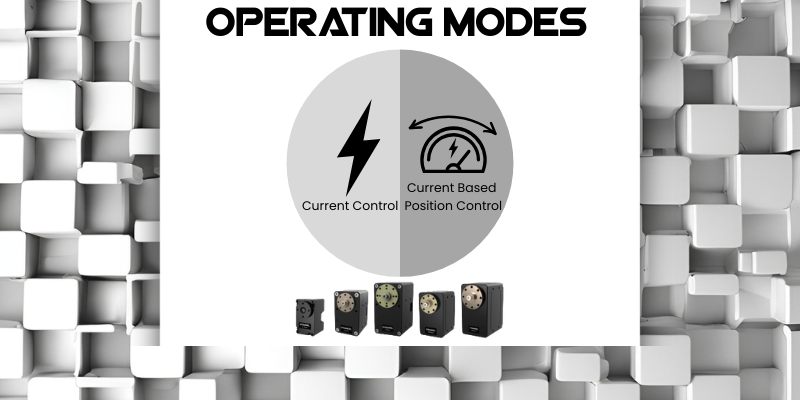
Current Based Control Modes
Posted by Mason Knittle on 19th Dec 2025
Not all robotic applications prioritize precise positioning. In many real-world scenarios (i.e. grippers, collaborative robots, compliant joints, or force-sensitive mechanisms) controlling torque safely and predictably matters just as much, if not more, than controlling position. Many DYNAMIXEL smart actuators support this through two closely related operating modes: Current Control Mode and Current-Based Position Control Mode. Although these modes sound similar, they solve very different problems. This article explains how each works, how they differ, and when to use one over the other.

What Is Current Control Mode?
Current Control Mode allows you to command a DYNAMIXEL actuator by specifying a target motor current instead of a position or velocity.
- Set a Goal Current (Most of the time, this is Control Table Address
102, but double check your DYNAMIXEL's control table to verify this) - Motor current is directly regulated by the internal controller
- Torque output is proportional to current
- No position or velocity target is enforced
In this mode, the actuator rotates continuously in the direction indicated by the sign of the commanded current.

How Current Control Mode Works
Internally, the DYNAMIXEL focuses on a single objective: achieving the commanded motor current.
- The actuator adjusts output to reach the Goal Current
- Higher current produces higher torque
- Present Current (Address
126) provides real-time feedback on motor load
What Is Current-Based Position Control Mode?
Current-Based Position Control Mode extends traditional position control by adding an explicit torque limit.
- The actuator moves toward a Goal Position
- Output torque is constrained using Goal Current
- Position control is maintained only within the allowed current limit
If the actuator encounters resistance, it will stop increasing torque once the current limit is reached, even if the target position has not been achieved.

Key Differences Between the Two Modes
- Current Control Mode: Torque is the primary control variable.
- Current-Based Position Control Mode: Position is primary, torque is limited.
- One allows endless rotation; the other targets a specific angle.
Which Mode Should You Use?
Choose Current Control Mode when torque or force is your primary concern and position is handled externally. Choose Current-Based Position Control Mode when you need accurate positioning with built-in torque limits for safety or compliance.
More Control Modes