


2025 DYNAMIXEL Roundup - Where We've been, and Where We're Going.
Posted by Mason Knittle on 15th Dec 2025
2025 DYNAMIXEL Roundup
A year-in-review for ROBOTIS: new platforms, actuator advances, community projects, and a price move that makes building easier.
Jump To:
2025 Highlights
AI Worker
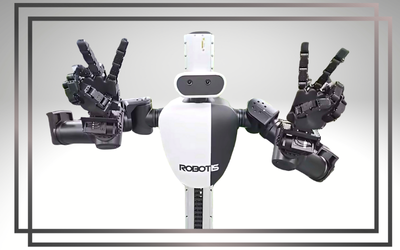
2025 gave us the AI Worker (FFW-SG2) as a flagship physical AI research platform. It is a semi-humanoid, mobile system built to learn from human demonstrations and run imitation learning and reinforcement learning pipelines end to end. The package purposely blends hardware and software: dual arms and dexterous hands are paired with open source ROS 2 packages, URDF models, and training resources so researchers can move from data collection to inference without rebuilding the stack.
The AI Worker turned our research tooling into a shareable platform. Watch Now.
OMY
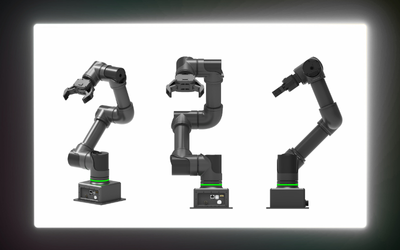
OMY arrived as a compact 6-DOF manipulator designed around the new DYNAMIXEL-Y actuator family. In practice, OMY is positioned as a research and automation arm that prioritizes smooth, repeatable manipulation. The product line includes leader and follower configurations, camera-enabled gripper variants, and ROS 2 native tooling so teams can prototype imitation learning and teleoperation workflows quickly.
Practice and learn virtually, react physically. Watch Now.
OMX
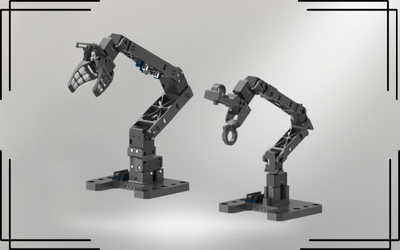
OMX was our education and hobbyist friendly manipulator launch for 2025. Designed to be plug and play, OMX lowers the barrier to entry for classrooms and makerspaces by focusing on rapid assembly, clear documentation, and straightforward ROS 2 support.
Educators, hobbyists, and labs that needed a simple physical AI testbed without heavy integration overhead. Watch Now.
DYNAMIXEL-Y actuators 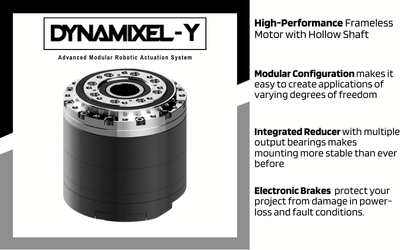
The DYNAMIXEL-Y family became the technical heart of several 2025 platforms. These actuators focus on high torque density, fine resolution, and modular integration with the DYNAMIXEL control ecosystem. Their cycloidal reduction and mechanical design give them more durability and load handling than many prior entry-level parts while maintaining the same friendly control surface users expect from DYNAMIXEL.
High torque density plus native SDK and ROS 2 compatibility means developers can move from simulation to real hardware faster and with fewer surprises.
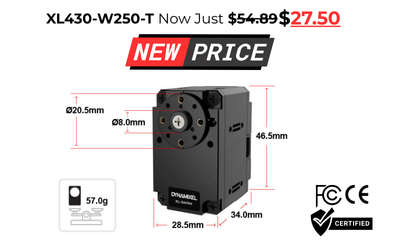
XL430-W250-T price drop!!!
Mid-2025 saw price adjustments for the XL430-W250-T which made the XL430-W250-T and related variants notably more affordable. That move lowered entry cost for new builders and educational programs and carried forward as a purchasing trend into 2026.
Cheaper XL430s mean more classrooms can justify full-robot kits and more makers can build multi-actuator projects without budget panic.
The DYNAMIXEL Ecosystem and Community Projects
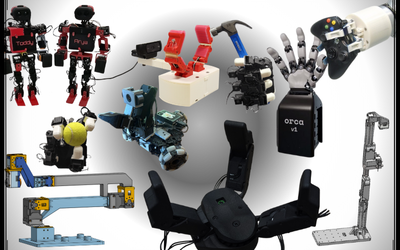
ROBOTIS and Artificial Intelligence
This year, robotics saw a major shift from scripted motion to systems that learn through interaction, a transformation powered by tight integration between simulation, AI training, and physical hardware. In 2025, many AI robotics projects using DYNAMIXEL followed simulation-first workflows built on Gazebo and NVIDIA Isaac Sim, with increasing interest in foundation-model approaches like NVIDIA Isaac™ GR00T for general-purpose robot learning. These tools allow teams to train policies, test perception, and iterate on control strategies in simulation before transferring them to real robots, reducing both development time and hardware risk.
ROBOTIS has embraced this AI-driven landscape by providing a Physical AI Pipeline that spans entry-level to enterprise-grade robotics platforms.
-
OMX: Entry-level platform ideal for learning, experimentation, and prototyping with accessible, modular DYNAMIXEL hardware.
-
OMY: Intermediate, industrial-focused platform designed for more complex AI workflows, enabling robust simulation-to-real transfers and higher payloads or precision.
-
AI Worker: Research and enterprise-level solution built for large-scale AI experimentation, high-performance training, and deployment of foundation models in real-world robotics applications.
All three platforms include ROS 2 support, URDF models, and SDKs that integrate seamlessly with Gazebo and Isaac Sim, making DYNAMIXEL a common choice for imitation learning, reinforcement learning, and teleoperation pipelines. Paired with durable DYNAMIXEL-Y actuators, this ecosystem enables teams to move learned policies from simulation into real-world execution efficiently. By combining simulation-first AI workflows with a spectrum of physical platforms, ROBOTIS helps teams turn foundation models into robots that can operate, adapt, and scale in real environments.
3) Looking Ahead to 2026
Next-Gen Dexterity: Fingers and Hands
In 2026, we're continuing to expand the reach of physical AI research and robotics education with a focus on dexterity. New finger actuators and a fully articulated robotic hand are on the horizon, designed to work seamlessly with existing DYNAMIXEL-Y platforms. These additions will let developers experiment with fine manipulation, grasping, and human-like hand behaviors, opening doors for more sophisticated imitation learning, teleoperation, and object interaction experiments.
YM110 – bigger, stronger, and smarter
The DYNAMIXEL-Y family grows with the upcoming new size YM110, a high-torque, modular actuator in the Y size class. Its design emphasizes durability and precision, enabling research and industrial projects that require heavier payloads, longer duty cycles, or more robust mechanical performance. Like its siblings, it will integrate smoothly with ROS 2, URDF models, and the DYNAMIXEL ecosystem, keeping simulation-to-real workflows fast and predictable.
Modular experimentation and beyond
With these additions, 2026 is shaping up to be a year of advanced robotics experimentation. Developers and educators will be able to mix and match manipulators, hands, and actuators more freely, test new control algorithms, and push the boundaries of AI-driven physical interaction—all without rebuilding entire robots from scratch.
Wrapping up 2025
2025 was about making high performance more approachable. We launched platforms that bring imitation learning into physical labs, introduced actuators that increase both torque and reliability, and helped lower the cost of entry for builders and classrooms. The community response and the number of creative projects we saw were the most meaningful metrics of all. Keep building, remixing, and sharing.