

ROBOTIS and Eurobotics Advance Real-World Humanoid Mobility
Built to Walk Into the Real World.
ROBOTIS and Eurobotics are bringing advanced humanoid hardware, autonomous walking intelligence, and open development together starting with AI Sapiens K1.
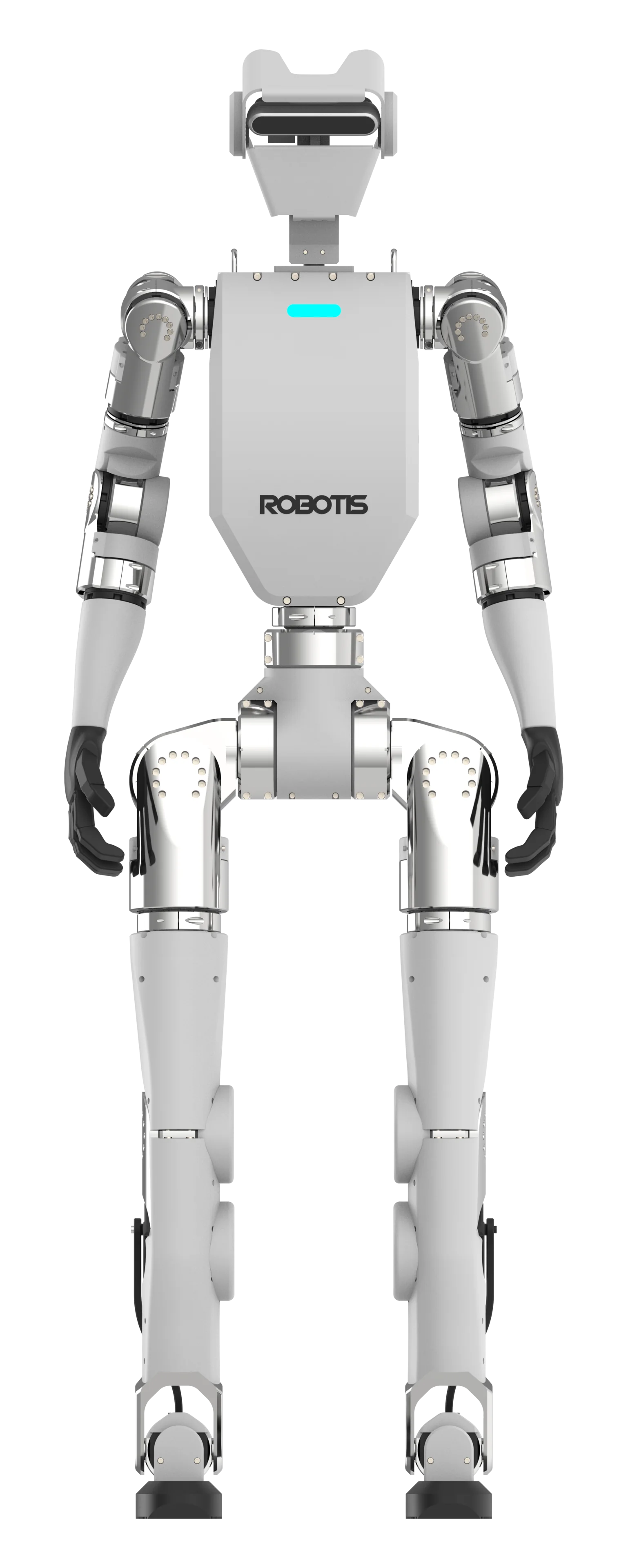

Hardware meets mobility intelligence.
On August 28, 2026, ROBOTIS and Eurobotics signed a memorandum of understanding to advance bipedal humanoid technology and accelerate its movement from controlled demonstrations into complex, real-world environments.
The collaboration brings together two complementary strengths. ROBOTIS contributes its humanoid hardware platform, actuator technology, and open control ecosystem. Eurobotics contributes autonomous mobility and walking AI designed to help robots perceive terrain, respond to changing conditions, and move independently.
The first focus is AI Sapiens K1. Eurobotics plans to integrate its mobility kit and walking technology, advanced from the DreamWaQ research developed by its founders at KAIST, with the ROBOTIS humanoid platform. The teams will jointly pursue prototype development, technical validation, and new industrial applications.
- Advance bipedal walking and autonomous mobility
- Develop and validate integrated prototypes
- Test adaptability beyond standardized indoor environments
- Explore deployment across demanding industries
A capable humanoid needs more than balance.
Reliable mobility emerges when intelligence, control, and actuation are developed as one connected system. A robot must understand where it is going, continuously decide how to move, and execute those decisions through joints built for dynamic physical interaction.
Read the environment
Mobility begins with awareness of terrain, obstacles, contact, and the changes that make real spaces less predictable than a laboratory floor.
Adapt the motion
Walking intelligence must convert perception into stable, responsive movement, not a single fixed sequence that only works under ideal conditions.
Command every joint
High-performance actuators turn policy outputs into coordinated whole-body motion while managing force, compliance, speed, and impact.
The muscle behind the motion.
A locomotion policy is only as capable as the joints that carry it into the physical world. DYNAMIXEL-Q is ROBOTIS' Quasi-Direct Drive actuator family engineered for high-performance humanoids.
Its low-ratio QDD architecture is designed to combine explosive torque with responsive, elastic behavior and shock absorption qualities that matter when a humanoid is shifting weight, recovering balance, making contact, or adapting its gait in real time.
Across the current QC lineup, DYNAMIXEL-Q scales from compact 110 W joints to 430 W-class actuation, giving developers a common control foundation for different positions across the humanoid body. Integrated feedback and impedance control help connect high-level motion intelligence to the mechanics of real contact.
Explore DYNAMIXEL-Q →Two platforms. Two paths into the real world.
The Eurobotics collaboration begins with AI Sapiens K1, but it sits within a broader ROBOTIS strategy: develop open robot platforms that help researchers and companies move intelligence from simulation and demonstrations onto real hardware.
AI Sapiens K1
AI Sapiens is ROBOTIS' end-to-end humanoid platform for developing motion, learning, and control on real hardware. It connects reinforcement learning, imitation learning, whole-body motion, simulation, and physical deployment in one open development path.
The platform is designed for hardware-aware development: policies can be trained and refined in simulation, then validated against real dynamics, contact, and actuation. ROBOTIS plans to share resources spanning mechanical and electrical hardware, robot software, simulation assets, training workflows, and deployment guides.
Meet AI Sapiens →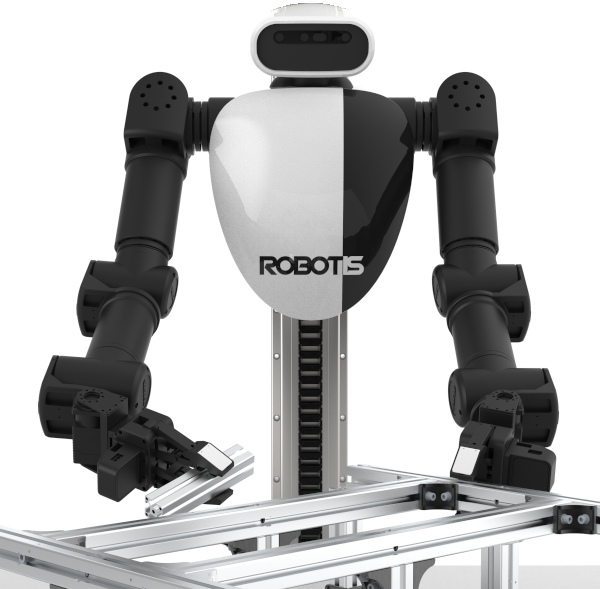
AI Worker
AI Worker brings Physical AI to industrial manipulation. Its mobile base, dual 7-DOF arms, and high-DOF dexterous-hand system are designed for delicate, complex work such as wiring harness assembly, welding, and inspection.
Instead of requiring every new task to be programmed line by line, AI Worker can learn from human demonstrations and refine behavior through imitation and reinforcement learning. An integrated pipeline connects teleoperation, data collection, visualization, training, and inference, while swerve-drive mobility supports precise omnidirectional movement in limited workspaces.
Explore AI Worker →Real terrain. Real contact. Real work.
The next milestone for humanoid robotics is not simply walking on a clean, level surface. It is maintaining useful behavior where obstacles, changing terrain, tight spaces, tools, people, and uncertainty are part of the job.
Navigate work cells and support processes that require both movement and manipulation.
Adapt mobility to unfinished spaces, obstacles, and variable ground conditions.
Reach complex work areas where access, balance, and coordinated motion matter.
Move through facilities, perceive changing conditions, and gather actionable information.
Support mobility research for demanding environments and high-risk operations.
Extend robotic capability into unpredictable areas where human exposure carries risk.
When hardware, control, simulation, and learning tools are open to inspection and improvement, a robot becomes more than a finished machine. It becomes a platform the robotics community can build upon.
ROBOTIS describes its actuator technology as “the engine of the robot”—a foundation that makes opening and extending the control stack possible.Build the body. Open the platform. Teach it to move.
The ROBOTIS and Eurobotics MOU is a commitment to turn complementary technology into working, validated humanoid capability. Prototype development and real-world testing will be the next steps—and AI Sapiens K1 will be the first platform to carry that collaboration forward.
By combining autonomous walking intelligence, scalable high-performance actuation, and an open Physical AI stack, the partnership aims to help humanoids move beyond carefully controlled demonstrations and toward meaningful work in the environments that need them most.