


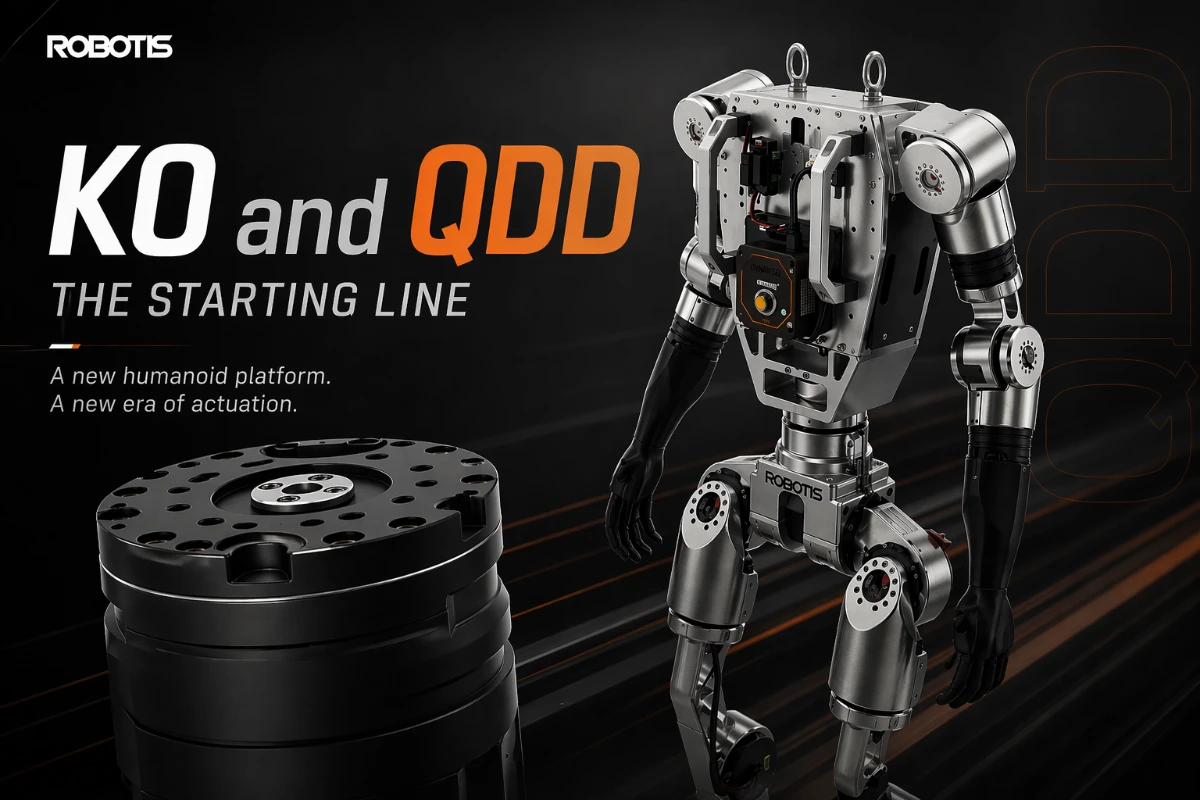
K0 and QDD - The Starting Line
Posted by Mason Knittle on 23rd Apr 2026
ROBOTIS AI SAPIENS
K0 Is Just the First Step
The AI Sapiens teaser introduces K0 — a 1.3 m humanoid platform built for Physical AI. However, the real shift is underneath: a new actuator architecture designed for dynamic, real-world motion.
From DYNAMIXEL X and P Series to DYNAMIXEL-Q
Traditional DYNAMIXEL families such as the X Series and P Series are widely used in robotics for their precision, reliability, and ease of integration.
These actuators typically use higher gear reduction to achieve strong torque output and stable position control. That makes them ideal for applications like robotic arms, mobile robots, and structured manipulation systems.
DYNAMIXEL-Q takes a different approach.
Rather than optimizing for rigid positional control, it is designed for dynamic motion and interaction, especially in systems like humanoids and legged robots.

What Is Quasi Direct Drive (QDD)?
DYNAMIXEL-Q is built around Quasi Direct Drive (QDD) actuation.
QDD reduces gear ratios while using a higher torque motor. This combination enables:
- Greater backdrivability
- Lower mechanical impedance
- More responsive torque behavior
- Improved interaction with external forces
In practical terms, this means the actuator behaves less like a rigid motor and more like a responsive mechanical system.
That distinction becomes critical in humanoid robotics.
Why QDD Matters for Humanoids
Humanoid robots operate in environments where contact is unavoidable. Walking, balancing, and recovering from disturbances all require the ability to react dynamically.
High reduction actuators can resist external forces, but they are less suited for fluid, adaptive motion.
QDD-based actuators, on the other hand, allow for:
More natural motion under load Better energy transfer during locomotion Safer interaction with the environment More effective torque-based control strategies
For Physical AI workflows - especially those involving reinforcement learning - these characteristics are essential.
|
DYNAMIXEL-Q
Actuator Lineup (Subject to Change)
Designed to scale across humanoid systems, the DYNAMIXEL-Q series provides a consistent Quasi Direct Drive architecture across multiple actuator sizes.
A unified actuator architecture allows seamless scaling across joints and robot sizes.
K0 integrates QM-060 and QM-080 as part of its core motion system.
|

K0: The First AI Sapiens Platform
K0 is the first humanoid platform in the AI Sapiens ecosystem.
It is designed not as a closed product, but as a development platform that supports:
Hardware customization, Simulation workflows, Learning-based control, and Real-world deployment
The goal is to provide a system that developers and researchers can build on — not just observe.
The First Step Toward a Scalable Platform.
K0 represents the first step in a broader ecosystem.
AI Sapiens is designed to grow across actuator configurations, robot form factors, software stacks, learning pipelines, and developer tools, forming a platform that can evolve alongside advances in robotics and Physical AI. At the center of that evolution is a shift in how robots move and interact with the world. DYNAMIXEL-Q introduces a new actuator approach that prioritizes responsiveness and dynamic behavior, not just precision. In that sense, the AI Sapiens teaser is more than a first look at K0: it marks the beginning of a transition toward more adaptive, real-world capable robotic systems.